Most people assume a contract must be written down, signed, notarized, and filed away before it becomes legally enforceable.
I’ve heard countless people say things like:
“We never signed anything.”
“It was just a conversation.”
“There wasn’t even any paperwork.”
What surprises many people is that a verbal agreement can sometimes be just as legally binding as a written contract.
That doesn’t mean every conversation creates a contract. However, under the right circumstances, a simple verbal agreement may be enforceable in court.
Understanding when an oral agreement can become legally binding may help you avoid expensive mistakes and legal disputes in the future.
What Is a Verbal Agreement?
A verbal agreement, sometimes called an oral contract, occurs when two or more parties agree to certain terms without creating a written document.
For example:
- A homeowner agrees to pay a contractor to build a deck.
- A friend agrees to loan another friend money.
- A business owner agrees to purchase goods from a supplier.
- Someone agrees to perform services in exchange for payment.
Many of these agreements happen every day without anyone signing a formal contract.
The important question is whether the agreement meets the legal requirements necessary to create an enforceable contract.
Can a Verbal Agreement Really Be Enforceable?
In many situations, yes.
Courts generally focus on whether the essential elements of a contract exist rather than whether the agreement was written down.
For a contract to exist, there is usually a need for:
- An offer
- Acceptance
- Consideration
- Mutual intent
If those elements are present, a valid contract may exist even if there is no paperwork.
This surprises many people because movies and television often make it seem like contracts only matter when signatures are involved.
Real life is often more complicated.
What Is an Offer?
An offer occurs when one party proposes a specific arrangement.
For example:
“I’ll paint your house for $3,000.”
That statement alone does not create a contract.
However, it may become the foundation for one.
The offer must be clear enough that another person can accept it.
What Is Acceptance?
Acceptance occurs when the other party agrees to the proposed terms.
For example:
“Yes, I’ll pay you $3,000 to paint my house.”
At that point, the parties may have formed an agreement.
Courts often examine the words, actions, and conduct of both parties when determining whether acceptance occurred.
What Is Consideration?
Consideration is one of the most important concepts in contract law.
In simple terms, consideration means each side is giving or promising something of value.
Examples include:
- Money
- Labor
- Services
- Property
- Goods
- Promises
Without consideration, there may not be a legally enforceable contract.
For example, promising to give someone a free gift is generally different from entering a contract where both parties exchange something valuable.
Why Are Verbal Agreements So Difficult?
The biggest problem is usually proof.
The agreement may be valid, but proving exactly what was said can become challenging.
Months later, people often remember conversations differently.
One person may believe payment was due immediately.
The other may believe payment was due six months later.
One person may believe additional work was included.
The other may disagree.
Without written documentation, disputes become much harder to resolve.
How Can You Prove a Verbal Agreement?
Evidence often becomes critical.
Helpful evidence may include:
- Text messages
- Emails
- Witness testimony
- Payment records
- Bank transfers
- Invoices
- Receipts
- Recorded communications where legal
Documentation can make an enormous difference when disputes arise.
This is one reason evidence plays such an important role throughout the legal system.
If you’re interested in how documentation affects legal disputes, you may also want to read 10 Types of Proof That Can Strengthen Your Insurance Claim Case.
Are Handshake Agreements the Same Thing?
In many cases, yes.
A handshake agreement is often simply a verbal agreement accompanied by a physical gesture confirming the deal.
Many people still believe a handshake automatically creates a legally binding contract.
The reality is slightly more complicated.
The handshake itself is not what creates the contract.
The legal elements behind the agreement are what matter.
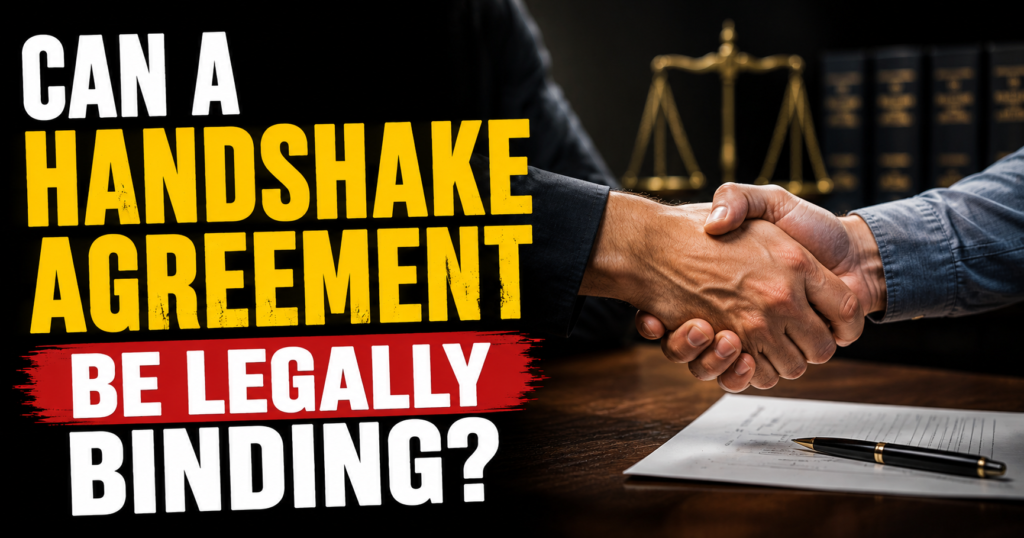
For a deeper look at this topic, read Can a Handshake Agreement Be Legally Binding?.
Are There Situations Where a Written Contract Is Required?
Absolutely.
Certain agreements often must be in writing to be enforceable.
Depending on state law, examples may include:
- Real estate transactions
- Certain long-term agreements
- Some debt arrangements
- Certain business contracts
- Other transactions covered by the Statute of Frauds
These requirements vary from state to state.
That is why legal advice can be valuable when significant money or property is involved.
Can Text Messages Create a Contract?
Many people are surprised to learn they sometimes can.
Modern courts increasingly examine electronic communications when evaluating contract disputes.
A series of text messages may help establish:
- An offer
- Acceptance
- Payment terms
- Agreed responsibilities
In some situations, text messages become some of the strongest evidence available.
This is one reason people should think carefully before agreeing to important business arrangements through casual conversations.
What Happens If Someone Breaks a Verbal Agreement?
If a valid contract existed, legal remedies may be available.
Potential remedies may include:
- Monetary damages
- Reimbursement of losses
- Settlement negotiations
- Court judgments
Many smaller disputes end up in Small Claims Court because the amounts involved fall within the court’s limits.
Larger disputes may proceed through traditional civil litigation.
Common Verbal Agreement Disputes
I’ve noticed several situations appear repeatedly.
Loans Between Friends
Money changes hands.
Months later nobody agrees on repayment terms.
Home Improvement Projects
Contractors and homeowners disagree about pricing, timelines, or project scope.
Business Deals
Business owners rely on trust rather than documentation and later disagree about responsibilities.
Family Arrangements
Informal agreements among family members often create disputes because expectations were never clearly documented.
How Can You Protect Yourself?
The best protection is surprisingly simple.
Put important agreements in writing.
Even a basic written document can help prevent future misunderstandings.
At a minimum, document:
- Names of the parties
- Payment amounts
- Deadlines
- Responsibilities
- Deliverables
- Important terms
A few minutes spent documenting an agreement today may save months of headaches later.
When Should You Talk to an Attorney?
Not every disagreement requires legal representation.
However, legal guidance may be worth considering when:
- Significant money is involved.
- Real estate is involved.
- A business dispute exists.
- One party refuses to perform.
- Major financial losses occurred.
Understanding your rights early often helps prevent larger problems later.
You may also find helpful resources in our Contracts section, Business Law category, and Civil Lawsuits resource center.
The Bottom Line
A verbal agreement is not automatically worthless simply because nothing was written down.
In many situations, oral agreements can create legally binding obligations.
The challenge is often proving what was agreed upon.
That is why I always recommend documenting important agreements whenever possible. Written contracts may require a little extra effort upfront, but they often provide clarity, protection, and peace of mind when disputes arise later.
About the Author
Michael Harrington
Michael Harrington is a legal researcher and writer who focuses on helping everyday Americans understand contracts, consumer rights, business law, insurance claims, and other common legal issues. His goal is to explain complex legal concepts in simple language that readers can actually use in real life.
As an Amazon Associate we earn from qualifying purchases through some links in our articles. Learn more.