Most people think a contract has to be written on paper, signed by both parties, and filed away in a folder somewhere to be legally enforceable.
I’ve heard people say things like:
“Don’t worry, we never signed anything.”
Or:
“It was just a handshake deal.”
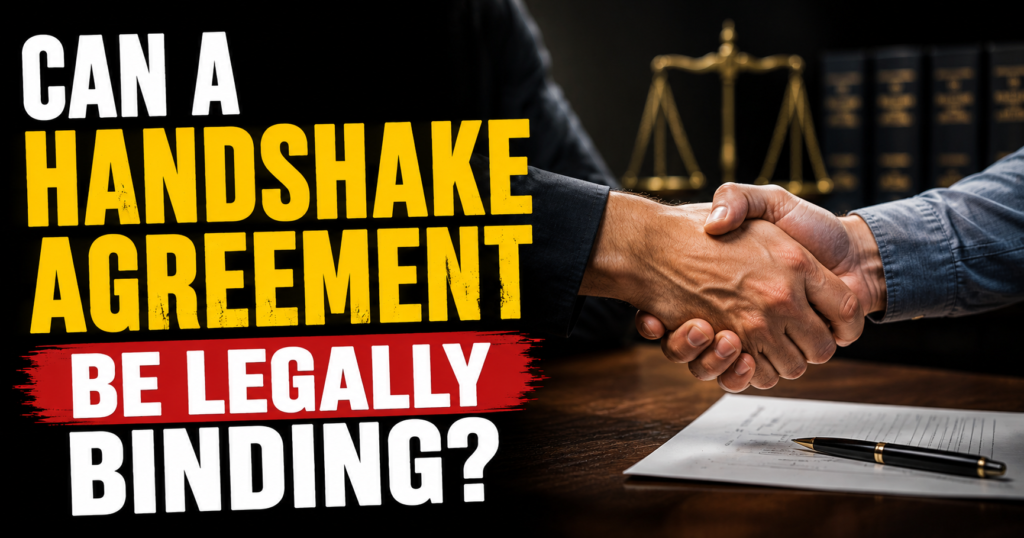
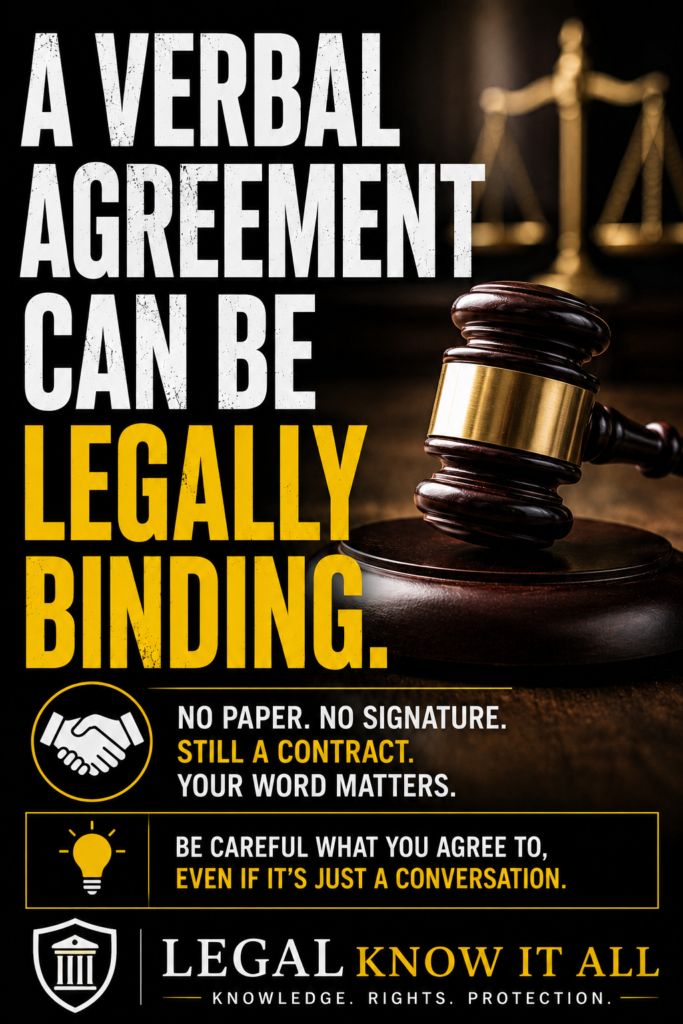
The reality is that many verbal agreements and handshake deals can be legally binding under the right circumstances.
That surprises a lot of people.
While written contracts are usually easier to prove in court, the lack of a written document does not automatically mean an agreement is worthless.
Understanding when a handshake agreement may be legally enforceable can help protect you from costly misunderstandings and legal disputes.
What Is a Handshake Agreement?
A handshake agreement is exactly what it sounds like. A handshake deal is one type of arrangement covered by Are Verbal Agreements Legally Binding?.
Two people discuss terms, reach an agreement, and commit to the deal without signing a formal written contract.
Historically, handshake agreements were extremely common.
In many communities, a person’s word was considered just as important as a written document.
Even today, countless business deals, home improvement projects, sales transactions, and service agreements begin with verbal promises and a handshake.
The legal question is whether that agreement meets the requirements of a valid contract.
Can a Verbal Agreement Be a Contract?
In many situations, yes.
A contract does not automatically require a written document.
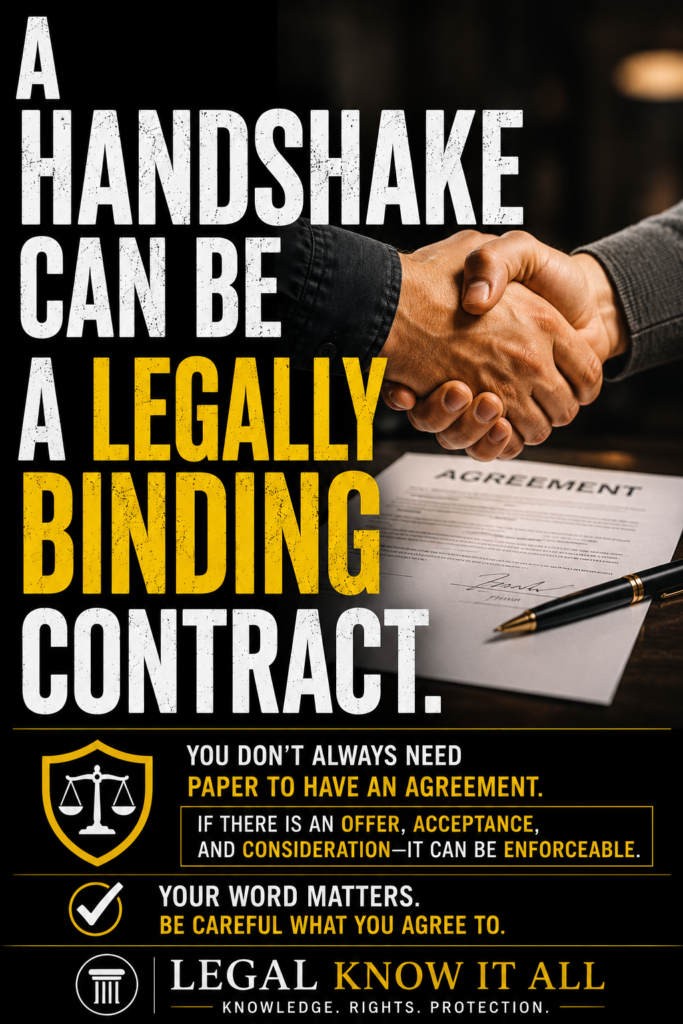
For a contract to exist, several basic elements are generally required:
- An offer
- Acceptance
- Consideration
- Intent to create an agreement
If those elements exist, a legally enforceable contract may exist even if nothing was ever written down.
This is why people should be careful about making promises or agreeing to deals without fully thinking through the consequences.

What Is Consideration?
One of the most important concepts in contract law is consideration.
In simple terms, consideration means each side gives or promises something of value.
Examples include:
- Money
- Services
- Property
- Goods
- Promises to perform certain actions
For example:
“I’ll pay you $500 to paint my fence.”
If the other person agrees, there may be an enforceable agreement because both sides are exchanging something of value.
Why Written Contracts Are Usually Better
Just because a handshake agreement can be legally binding doesn’t mean it’s a good idea.
I’ve seen countless disputes arise because people remembered conversations differently.
Months later, one person may remember the agreement one way while the other remembers it completely differently.
Written contracts help answer questions such as:
- What was agreed upon?
- When was performance due?
- How much money was involved?
- What happens if someone fails to perform?
A written document creates a record that can help prevent disputes before they happen.
How Do You Prove a Handshake Agreement?
This is where many people run into problems.
The agreement may be legally valid, but proving it existed can be difficult.
Evidence that may help prove a verbal agreement includes:
- Text messages
- Emails
- Witness testimony
- Payment records
- Bank transfers
- Recorded communications where legal
- Invoices
- Receipts
This is one reason documentation is so important.
Much like insurance claims rely on evidence, contract disputes often come down to proving what actually happened.
If you’re interested in how evidence affects legal disputes, read 10 Types of Proof That Can Strengthen Your Insurance Claim Case.
Are All Verbal Agreements Enforceable?
No.
Certain agreements often must be in writing under state laws.
These situations vary, but commonly include:
- Real estate transactions
- Certain long-term contracts
- Some business agreements
- Certain debt-related agreements
- Other transactions governed by state law
These requirements are often associated with legal rules commonly known as the Statute of Frauds.
The exact requirements vary depending on where you live.
What Happens If Someone Breaks a Handshake Deal?
If a valid contract existed and one party fails to uphold their end of the agreement, legal remedies may be available.
Possible outcomes can include:
- Monetary damages
- Reimbursement of losses
- Court orders in certain situations
- Settlement negotiations
Many smaller contract disputes end up in Small Claims Court because the amount of money involved falls within the court’s jurisdictional limits.
Can Text Messages Create a Contract?
Many people don’t realize text messages can sometimes become important evidence in contract disputes.
A series of messages may show:
- An offer
- Acceptance
- Agreement on price
- Agreement on terms
Courts increasingly examine electronic communications when evaluating whether an agreement existed.
This is another reason people should be careful about casually agreeing to deals through text messages or social media messages.


What About Business Deals?
Business owners frequently rely on informal agreements.
Unfortunately, business disputes involving verbal promises can become expensive very quickly.
I’ve seen situations where:
- Partnerships were formed without paperwork.
- Contractors began work without written agreements.
- Vendors delivered products without signed contracts.
- Friends started businesses based on trust alone.
While trust is valuable, written agreements often provide protection for everyone involved.
You can learn more about these issues in our Business Law section.
Common Handshake Agreement Disputes
Some of the most common disputes involve:
- Home improvement projects
- Loans between friends
- Property sales
- Business partnerships
- Employment arrangements
- Service agreements
The problem is rarely the original agreement.
The problem usually appears later when the parties disagree about what was actually promised.
Can Witnesses Help Prove a Verbal Agreement?
Absolutely.
Independent witnesses may strengthen a case if they observed the agreement being made.
Witness testimony may help establish:
- What was discussed
- Who participated
- The agreed terms
- The intentions of the parties
However, witness testimony is usually strongest when combined with other supporting evidence.
How Can You Protect Yourself?
The simplest solution is surprisingly easy.
Get important agreements in writing.
Even a basic written document can help avoid confusion later.
At a minimum, consider documenting:
- Names of the parties
- Terms of the agreement
- Payment amounts
- Deadlines
- Responsibilities
The more important the transaction, the more important written documentation becomes.
When Should You Consult an Attorney?
Not every disagreement requires legal representation.
However, legal advice may be helpful when:
- Large amounts of money are involved.
- Real estate is involved.
- A business dispute exists.
- One party refuses to honor the agreement.
- Significant financial losses occurred.
Understanding your rights early can often prevent larger problems later.
You may also find helpful information in our Contracts section, Civil Lawsuits category, and Legal Questions resource center.
The Bottom Line on Handshake Agreements
A handshake agreement is not automatically meaningless simply because it wasn’t written down.
In many situations, verbal agreements can be legally binding when the necessary elements of a contract exist.
The challenge is often proving exactly what was agreed to.
That’s why I always recommend documenting important agreements whenever possible. A few minutes spent putting terms in writing today can save months of arguments and legal headaches later.
About the Author
Michael Harrington
Michael Harrington is a legal researcher and writer who focuses on helping everyday Americans better understand contracts, consumer rights, property disputes, insurance claims, and other common legal issues. His goal is to explain legal topics in plain English so readers can make informed decisions and better protect their rights.