
Most people carry more personal information in their phone than they keep anywhere else.
Think about it.
Your phone may contain:
- Photos
- Videos
- Text messages
- Emails
- Banking apps
- Social media accounts
- Search history
- Location information
- Contacts
That is one reason people become nervous when police ask to look at a phone.
I’ve found that many Americans are unsure what rights they actually have in these situations.
Some people assume police can search any phone whenever they want.
Others believe police can never access a phone without permission.
The reality is usually more complicated.
Quick Answer

Whether police may search a phone without permission can depend on factors such as warrants, consent, specific circumstances, constitutional protections, and applicable laws. Phone-search questions are often heavily fact-dependent. The related issue of Can Police Track Your Phone Without Permission? What the Law Says focuses on the location information a smartphone may reveal.
Why Phones Are Different Than Many Other Items
One thing that makes phones unique is the enormous amount of personal information they contain.
Years ago, someone might have carried a wallet, a few photographs, and a paper address book.
Today, much of a person’s life may be stored inside a single device.

Because phones often contain so much information, questions involving phone searches frequently raise significant privacy concerns. Those concerns are part of the broader question of What Happens If Police Search You Illegally?.



Constitutional Rights Often Become Central
When discussing phone searches, constitutional protections are often part of the conversation.
Many people immediately think about:
- Privacy
- Searches
- Warrants
- Government access
- Individual rights
That is one reason phone-search questions often receive significant legal attention.
For additional information, visit our:
Constitutional Rights Category
Permission Can Change The Situation
One thing I’ve learned is that many people overlook how important consent can be.
If a person voluntarily allows access to a phone, the situation may look very different from one where access is denied.
Because of that, questions involving consent often become an important part of phone-search discussions.
Phones Often Contain More Than People Realize

Many individuals think only about photographs and text messages. Questions about Can Police Access Deleted Text Messages? The Real Answer can add another layer to concerns about the information stored on a phone.
In reality, phones may also contain:
- Saved passwords
- Cloud accounts
- Location history
- App activity
- Browsing information
- Financial records
The sheer volume of information available is one reason phone searches often receive close scrutiny.
Social Media Creates Additional Questions
One thing that surprises many people is how often social media becomes part of investigations.
Photos, videos, comments, messages, and account activity may all become relevant depending on the circumstances.
You may also find helpful information in:

Can Social Media Hurt Your Insurance Claim?
While that article focuses on insurance claims, it demonstrates how information people post online can sometimes become evidence in unexpected ways.
Phones Are Often Connected To Other Devices
Modern phones rarely exist in isolation.
Many connect to:
- Smart watches
- Tablets
- Laptops
- Vehicles
- Cloud services
Because of that, questions involving phone searches sometimes become broader than people initially expect.
Why People Worry About Phone Searches
In my experience, people are often less concerned about the device itself and more concerned about the information stored on it.
A phone may reveal:
- Personal conversations
- Family information
- Business information
- Financial details
- Daily activities
That is why phone-search questions often feel more personal than questions involving many other types of property.


Understanding The Facts Matters
Whenever legal questions arise involving phones, I think it is important to avoid assumptions.
The answer often depends on:
- What happened
- Who was involved
- Whether permission existed
- Whether warrants were involved
- Applicable laws
The specific facts frequently determine how these situations are evaluated.
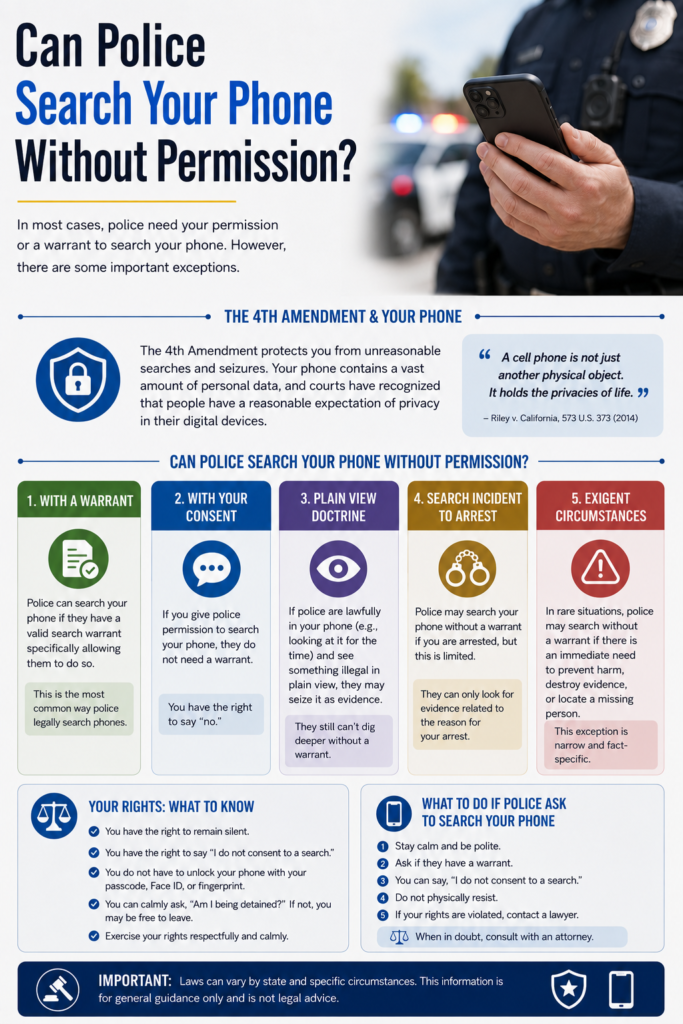
What About Search Warrants?
When most people think about police searching a phone, they immediately think about warrants.
That makes sense because warrants are one of the most commonly discussed legal tools associated with searches.
I’ve found that many people assume every phone search automatically requires the exact same process.
In reality, situations can vary depending on the facts involved.
That is one reason phone-search questions often become more complicated than they first appear.
Can You Refuse Permission To Search Your Phone?
One of the most common questions people ask is whether they can refuse permission when an officer asks to look through their phone.
Questions involving consent often become important because consent can affect how a situation is evaluated.
Many people feel pressured in these situations simply because they are nervous.
Others are unsure whether they have a choice.
That uncertainty is one reason understanding your rights before a stressful encounter can be valuable.
What If The Phone Is Locked?
Modern phones often contain security features such as:
- Passcodes
- PIN numbers
- Fingerprint access
- Facial recognition
- Two-factor authentication
These features have changed how people think about privacy and phone security.
As technology evolves, legal questions involving digital privacy continue to receive significant attention.
Biometric Unlocking Raises Additional Questions
One topic that has received increasing attention involves biometric security.
Many devices can now be unlocked using:
- Fingerprints
- Facial recognition
- Other biometric features
Because these technologies are relatively new compared to traditional locks and keys, they often create unique legal discussions.
What Happens After An Arrest?
Many people wonder whether an arrest automatically gives law enforcement unlimited access to a phone.
I’ve found that this is one of the most misunderstood areas involving phone searches.
The circumstances surrounding an arrest can affect many aspects of a case, which is why broad assumptions are often risky.
Every situation involves its own facts.
Phones Often Contain Evidence Beyond Messages
When people think about phone searches, they often focus on text messages.
Modern phones can contain much more than that.
Examples may include:
- Photos
- Videos
- GPS information
- Social media activity
- App usage
- Internet activity
Because of that, phone searches often involve significantly more information than many people realize.
Cloud Accounts Can Expand The Discussion
Many phones automatically connect to cloud-based services.
That means information may exist in multiple locations at the same time.
Questions involving:
- Cloud storage
- Online backups
- Account access
- Synced devices
can sometimes become part of broader discussions involving digital privacy and searches.
Phone Searches Often Lead To Other Constitutional Questions
One thing I’ve noticed is that people interested in phone-search rights are often interested in broader constitutional-rights issues as well.
You may also find helpful information in:

Can Police Search Your Car Without Permission?

Can Police Enter Private Property Without Permission?

Can Police Lie to You During an Investigation?
These topics frequently overlap because they all involve questions about government authority, privacy, and individual rights.
Technology Changes Faster Than The Law
One thing I’ve learned is that technology evolves incredibly fast.
Phones today are dramatically different from phones just a few years ago.
As technology changes, courts, lawmakers, and legal professionals continue addressing new questions involving:
- Privacy
- Digital evidence
- Data storage
- Electronic communications
That is one reason phone-search issues remain an active area of legal discussion.
Frequently Asked Questions
Can police search your phone without permission?
The answer often depends on factors such as warrants, consent, specific circumstances, constitutional protections, and applicable laws.
Does a locked phone have additional protections?
Security features such as passcodes and biometric locks frequently become part of legal discussions involving phone searches.
Can police ask for permission to search a phone?
Questions involving consent often play an important role in situations involving phone access.
What information can a phone contain?
Modern phones may contain photos, videos, messages, financial information, location data, app activity, and much more.
Do social media accounts matter?
Social media activity sometimes becomes relevant in investigations, legal disputes, and other proceedings.
Are cloud accounts part of the discussion?
Cloud storage, synced devices, and online backups can sometimes become relevant when discussing digital information.
Why are phone searches different from many other searches?
Phones often contain enormous amounts of highly personal information, making privacy concerns especially significant.
Where can I learn more about constitutional rights?
You can explore additional topics in our:
Constitutional Rights Category
Important Information
This article is provided for educational and informational purposes only and should not be considered legal advice. Constitutional protections, search-and-seizure laws, privacy rights, and criminal procedure rules vary depending on the facts involved and applicable laws. Consult a qualified attorney regarding your specific situation.
For more information about our content standards, visit our Editorial Policy and Fact-Checking Policy pages.
Additional information about this website can be found on our About Us, Contact Us, FAQ, Disclaimer, and Terms and Conditions pages.
About the Author
Sarah Reynolds is a legal research contributor for Legal Know It All who focuses on constitutional rights, criminal law, privacy issues, and practical legal topics affecting everyday Americans. She researches common legal questions involving searches, investigations, digital privacy, and individual rights while helping readers understand complex legal concepts in clear, straightforward language.