
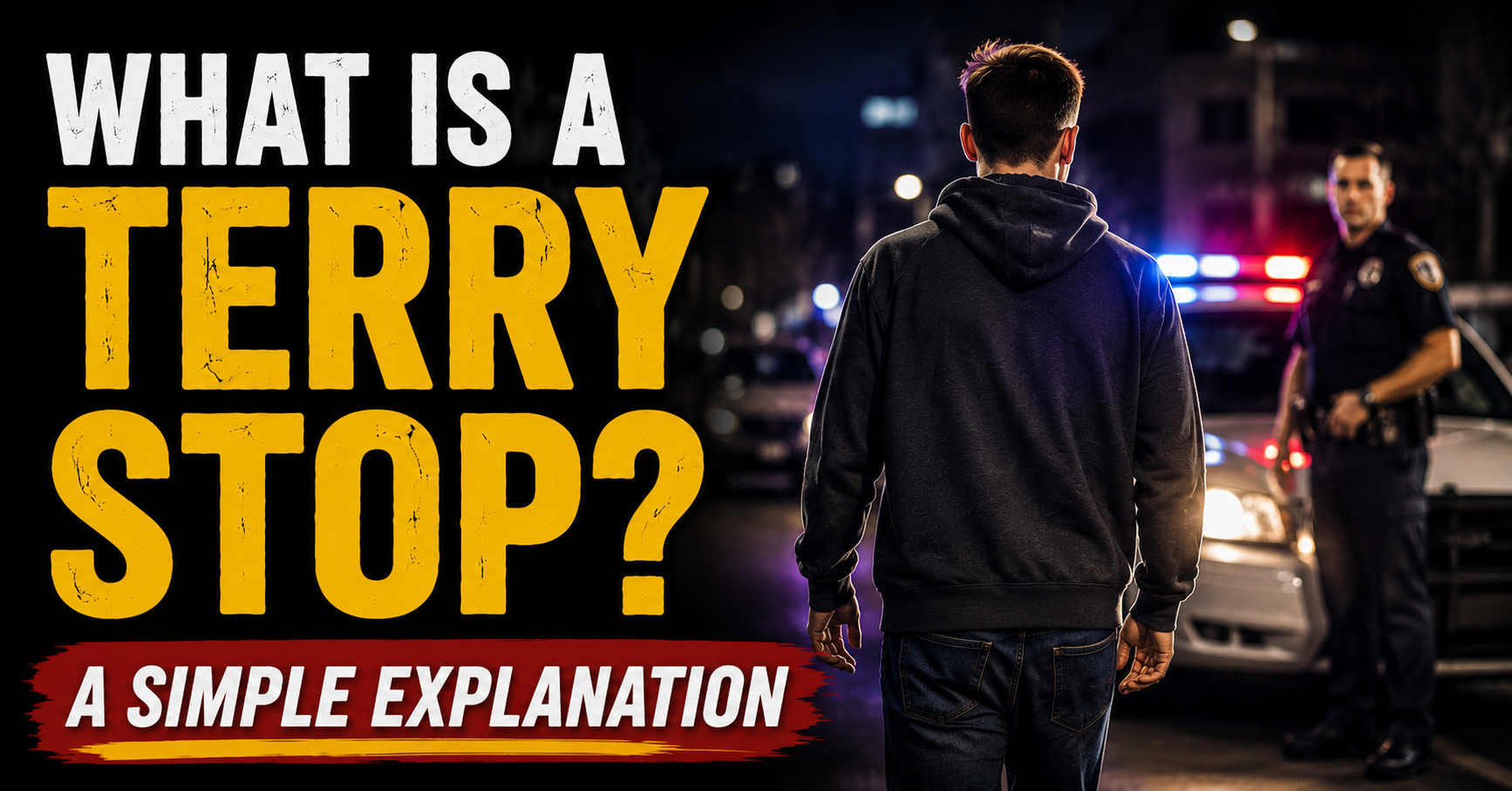
If you’ve spent much time reading about police encounters, you’ve probably come across the phrase “Terry stop.”
It appears in court opinions.
Attorneys discuss it.
Police officers receive training on it.
Yet many Americans have no idea what it actually means.
Some people assume it’s simply another name for a police stop.
Others believe it’s the same thing as an arrest.
Neither is correct.
A Terry stop is one of the most important legal concepts under the Fourth Amendment because it allows police officers, under certain circumstances, to briefly detain someone for investigative purposes without making an arrest. The doctrine comes from the U.S. Supreme Court’s landmark 1968 decision in Terry v. Ohio.
Quick Answer
A Terry stop is a brief investigative detention that generally allows a police officer to temporarily stop a person when the officer has reasonable suspicion that criminal activity is occurring, has occurred, or is about to occur. If the officer also reasonably believes the person is armed and dangerous, a limited pat-down for weapons may be permitted.
Where Did The Name “Terry Stop” Come From?
The term comes from the U.S. Supreme Court case Terry v. Ohio, decided in 1968.
In that case, an experienced police officer observed behavior that he believed suggested several men were preparing to rob a store.
The officer approached them, asked questions, and performed a limited pat-down after believing one of the men might be armed.
The Supreme Court ultimately held that the Fourth Amendment allows certain brief investigative stops when supported by reasonable suspicion. The Court also recognized that, when an officer reasonably believes a person is armed and dangerous, a limited frisk for weapons may be appropriate to protect officer safety.



A Terry Stop Is Not An Arrest
One of the biggest misconceptions I see is people assuming that being stopped automatically means they’ve been arrested.
That’s generally not true.
A Terry stop is intended to be a temporary investigative detention.
An arrest is a different legal event that generally requires the higher standard of probable cause.

If you’re still learning how temporary detentions work, you may also find Can Police Detain You Without Arresting You? What to Know helpful because it explains how investigative detentions differ from arrests.
Reasonable Suspicion Is The Foundation Of A Terry Stop
A Terry stop does not begin with probable cause.
Instead, it generally begins with reasonable suspicion.
That legal standard requires more than a mere hunch but less evidence than probable cause.
Understanding reasonable suspicion makes Terry stops much easier to understand because the two concepts are closely connected.
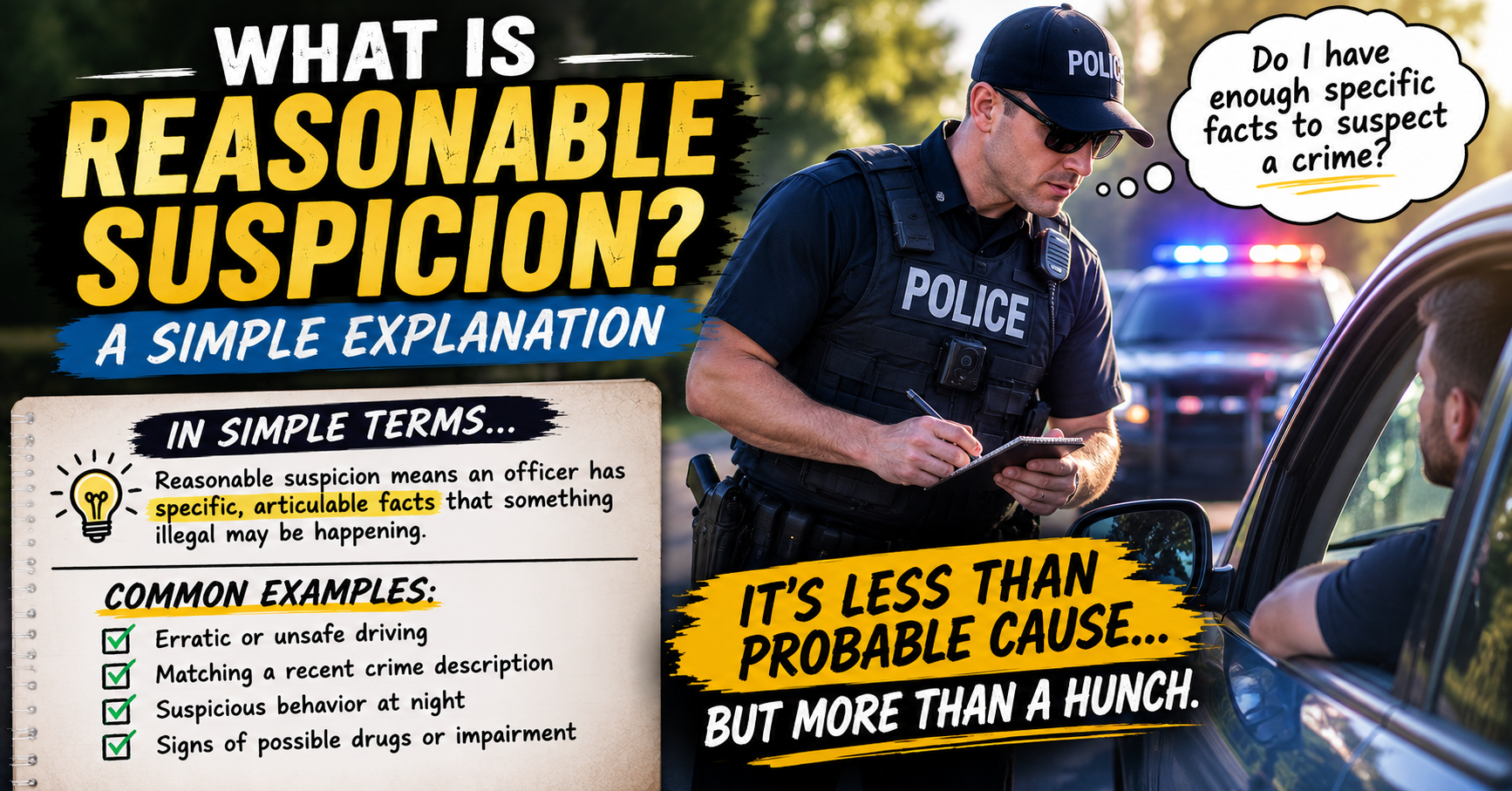
If you haven’t already, I recommend reading What Is Reasonable Suspicion? A Simple Explanation first since it provides the legal foundation for this topic.
A Terry Frisk Is Different From A Terry Stop
Another point that causes confusion is that people often use “Terry stop” and “Terry frisk” as though they mean the same thing.
They don’t.
A Terry stop refers to the temporary detention itself.
A Terry frisk refers to the limited pat-down for weapons that may occur during some Terry stops when the legal requirements are met.
That’s why not every Terry stop includes a frisk, and not every police encounter involves either one.
A Terry Stop Can Be Brief Without Becoming An Arrest
One thing that surprises many people is that a Terry stop is intended to be temporary.
Its purpose is to allow an officer to quickly investigate suspicious circumstances, not to place someone under arrest.
Because of that, courts generally examine whether the stop remained reasonably related in scope and duration to the reason for the stop. A stop that is unnecessarily prolonged or expanded beyond its original purpose can raise Fourth Amendment concerns.
Not Every Terry Stop Includes A Frisk
Another common misconception is that every Terry stop automatically includes a pat-down.
That’s not how the legal standard works.
A Terry stop and a Terry frisk are two separate concepts.
An officer may briefly detain someone based on reasonable suspicion of criminal activity.
A frisk generally requires an additional reasonable belief that the person may be armed and dangerous before the officer performs a limited pat-down of the outer clothing for weapons.

If you’d like a more detailed explanation of protective frisks, you may also find Can Police Pat You Down? Here’s When They Can helpful.
A Terry Stop Is Different From A Consensual Encounter
I’ve found that many people assume every conversation with a police officer is automatically considered a Terry stop.
That’s generally not true.
Police officers may approach people and ask questions without every interaction becoming an investigative detention.
A Terry stop generally occurs when a person has been temporarily detained based on reasonable suspicion rather than simply participating in a voluntary conversation.
Understanding that distinction helps explain why not every police encounter is analyzed under the same legal standard.



Terry Stops Frequently Lead To Other Fourth Amendment Questions
Many people who research Terry stops soon begin asking related questions.
For example:
- When does a detention become an arrest?
- What is reasonable suspicion?
- What is probable cause?
- When may police perform a frisk?
These legal concepts work together and form the foundation of many Fourth Amendment cases.
If you’re trying to understand the higher legal standard used in many arrests and search warrants, you may also find What Is Probable Cause? What Every American Should Know useful.
Common Misconceptions About Terry Stops
One misconception is that officers need probable cause before they can briefly stop someone.
Another is that every Terry stop automatically allows a full search.
Neither assumption is generally correct.
A Terry stop is based on reasonable suspicion, while a frisk is limited in scope and intended to protect officer safety rather than serve as a general search for evidence.
Frequently Asked Questions
What is a Terry stop?
A Terry stop is a brief investigative detention that generally allows an officer to temporarily stop someone based on reasonable suspicion of criminal activity.
Why is it called a Terry stop?
The name comes from the U.S. Supreme Court’s 1968 decision in Terry v. Ohio, which established the legal framework for these investigative stops.
Is a Terry stop the same as an arrest?
No. A Terry stop is generally a temporary investigative detention, while an arrest typically requires the higher legal standard of probable cause.
Does every Terry stop include a frisk?
No. A frisk is a separate protective measure that generally requires a reasonable belief the person is armed and dangerous.
Can a Terry stop become an arrest?
Yes. Depending on how an investigation develops, an encounter may change over time. Courts evaluate the facts surrounding each situation individually.
Why are Terry stops important?
They help explain many everyday police encounters involving temporary investigative detentions and are one of the foundational concepts of Fourth Amendment law.
Where can I learn more about constitutional rights?
Browse our Constitutional Rights category for additional guides covering police encounters, searches, privacy rights, and other constitutional topics.
Important Information
This article is provided for educational and informational purposes only and should not be considered legal advice. Fourth Amendment protections, criminal procedure rules, search-and-seizure law, and police practices vary depending on the facts involved and applicable laws. If you need legal advice regarding your specific situation, consult a qualified attorney licensed in your jurisdiction.
For more information about our editorial standards, visit our Editorial Policy and Fact-Checking Policy pages.
You can also learn more about Legal Know It All by visiting our About Us, Contact Us, FAQ, Disclaimer, and Terms and Conditions pages.
About the Author
Sarah Mitchell is a legal research contributor for Legal Know It All who focuses on constitutional rights, police encounters, civil rights, and criminal law. She researches common legal questions involving Fourth Amendment protections, police procedures, and search-and-seizure law while helping readers understand complex legal concepts in clear, practical language.