

Most people understand what an arrest is.
Police place someone into custody.
The person is not free to leave.
A criminal investigation may follow.
But many Americans are surprised to learn that not every police encounter involves an arrest.
That often leads to an important question:
Can police detain you without arresting you?
I’ve found that many people assume there are only two possibilities.
Either they are completely free to go.
Or they have been arrested.
The reality is often more complicated.
Police encounters frequently involve situations that fall somewhere between those two extremes.
Quick Answer

Whether police may detain someone without making an arrest often depends on factors such as the circumstances involved, applicable laws, constitutional protections, the officer’s actions, and the specific facts of the encounter. Those same encounter-specific factors can affect whether you may refuse to answer police questions in Can You Refuse to Answer Police Questions?.
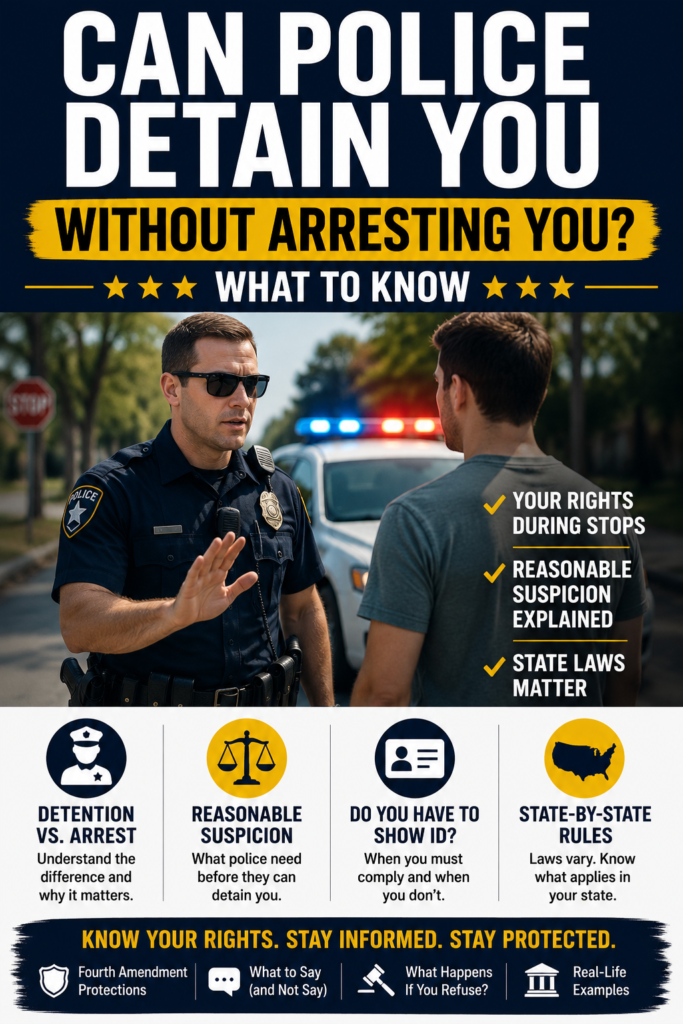
Why People Confuse Detention And Arrest
The confusion is understandable.
Both situations involve interactions with law enforcement.
Both may involve questioning.
Both may involve temporary restrictions on a person’s freedom of movement.
Because there are similarities, many people use the terms interchangeably even though they often refer to different situations.



Many Police Encounters Never Become Arrests
One thing I’ve noticed is that people often assume every police stop eventually leads to an arrest.
That is not necessarily true.
Many encounters involve:
- Brief questioning
- Identity verification
- Investigative activity
- Traffic stops
- Public interactions
without resulting in a formal arrest.
That is one reason detention-related questions continue generating significant public interest.
Constitutional Rights Often Become Part Of The Discussion
Questions involving detention frequently involve broader constitutional-rights issues.
People often want to understand:
- Their rights during a stop
- What police can ask
- Whether they can leave
- How long an encounter may last
Those concerns are a major reason detention-related topics remain important.
For example, readers may also find helpful information in Can Police Ask for ID If You Haven’t Done Anything Wrong? because identification questions frequently arise during police encounters.


Police Encounters Can Develop Quickly
Many interactions begin as routine situations.
An officer may approach someone.
Questions may be asked.
Information may be gathered.
The nature of the encounter can change depending on what occurs next.
That is one reason police-stop situations are often highly fact-specific.
The Difference Matters
I’ve found that many people researching this topic are really asking a deeper question:
“What is actually happening during this encounter?”

Understanding the distinction between different types of police interactions can help people better understand their rights and responsibilities. The role of custody and questioning is also important when reviewing What Are Your Miranda Rights?.
Because of that, detention and arrest discussions often receive significant attention from courts, legal professionals, and the public.
Detentions Often Connect To Other Constitutional Topics
Questions involving detention frequently overlap with other constitutional-rights issues.
For example, readers researching police stops may also be interested in:
- Reasonable suspicion
- Probable cause
- Police questioning
- Search-and-seizure issues
- Identification requirements
These topics often work together rather than existing separately.
Traffic Stops Raise Similar Questions
Many Americans first encounter detention-related concepts during traffic stops.
Even routine traffic encounters can raise questions involving:
- Police authority
- Constitutional protections
- Identification requests
- Temporary restrictions
That is one reason traffic stops remain one of the most commonly discussed constitutional-rights topics in America.



The Facts Usually Matter
One of the biggest misconceptions involving police detentions is the belief that every encounter follows the same rules.
The reality is often far more nuanced.
Questions involving detention frequently depend on:
- The circumstances
- The officer’s actions
- Applicable laws
- Constitutional protections
- Specific facts
That is one reason detention-related issues are often evaluated on a case-by-case basis.
Detained And Arrested Are Not Always The Same Thing
One reason this topic creates so much confusion is that many people assume detention and arrest mean exactly the same thing.
I’ve found that most Americans use the terms interchangeably.
However, legal discussions often treat them differently.
That distinction is one reason people frequently ask questions about what rights apply during various police encounters.
Understanding the difference can help explain why some situations feel similar while being treated differently under the law.
Police Encounters Can Escalate Quickly
A routine interaction may not remain routine.
An encounter that begins with a simple conversation can sometimes develop into something more serious depending on what occurs during the interaction.
For example, officers may gather information through:
- Observations
- Questions
- Witness statements
- Physical evidence
- Other investigative activity
Because situations can change rapidly, police encounters are often evaluated based on the specific facts involved.
Many People Focus On The Wrong Question
I’ve noticed that people often focus entirely on whether they were arrested.
In many situations, the more important question may be:
“What was the nature of the encounter?”
That question frequently becomes central to understanding what rights, protections, and obligations may apply.
Because of that, detention-related discussions often involve much more than the simple question of whether someone was placed under arrest.
Traffic Stops Often Introduce These Concepts
For many Americans, traffic stops provide their first experience with detention-related issues.
Even routine traffic stops can raise questions involving:
- Temporary restrictions
- Identification requests
- Police authority
- Constitutional protections
That is one reason readers interested in detention-related topics often continue researching other police-encounter questions.
For example, understanding identification requirements can be helpful when reviewing Can Police Ask for ID If You Haven’t Done Anything Wrong?
Constitutional Rights Remain An Important Part Of The Discussion
Questions involving detention frequently involve broader constitutional-rights concerns.
People often want to understand:
- Their rights during encounters
- What officers may do
- What citizens may do
- How interactions can change
That is why detention-related topics continue generating significant interest throughout the country.
Common Misconceptions About Police Detentions
One misconception is that every police encounter automatically becomes an arrest.
Another misconception is that officers and citizens always have complete freedom to end an interaction at any moment.
The reality is often much more nuanced.
Questions involving police encounters frequently depend on circumstances, applicable laws, constitutional protections, and specific facts.
That is one reason broad assumptions can sometimes create misunderstandings.
Police Detentions Often Lead To Other Constitutional Questions
People researching detention-related issues frequently continue exploring related topics.
Someone concerned about detention may also want to understand:
- Identification requirements
- Police questioning
- Search-and-seizure issues
- Traffic-stop rights
- Constitutional protections
These topics often work together and help create a broader understanding of police encounters.
Frequently Asked Questions
Can police detain you without arresting you?
The answer often depends on the circumstances involved, applicable laws, constitutional protections, and the specific facts surrounding the encounter.
Is being detained the same as being arrested?
Many people use the terms interchangeably, but detention and arrest are often discussed differently in legal contexts.
Why do people confuse detention and arrest?
Both situations involve interactions with law enforcement and may involve temporary restrictions on a person’s freedom of movement.
Can a routine police encounter become more serious?
Yes. Police encounters may evolve depending on the circumstances and information gathered during the interaction.
Why are traffic stops often discussed with detention issues?
Traffic stops are one of the most common situations where Americans encounter detention-related concepts.
Do constitutional rights apply during police encounters?
Questions involving detention frequently involve broader constitutional-rights concerns.
Why are detention cases so fact-specific?
The circumstances, actions involved, applicable laws, and constitutional protections can all affect how an encounter is evaluated.
Where can I learn more about constitutional rights?
You can browse additional topics in our:
Constitutional Rights Category
Important Information
This article is provided for educational and informational purposes only and should not be considered legal advice. Constitutional protections, criminal procedure rules, police-encounter laws, civil-rights issues, and search-and-seizure laws vary depending on the facts involved and applicable laws. Consult a qualified attorney regarding your specific situation.
For more information about our content standards, visit our Editorial Policy and Fact-Checking Policy pages.
Additional information about this website can be found on our About Us, Contact Us, FAQ, Disclaimer, and Terms and Conditions pages.
About the Author
Sarah Mitchell is a legal research contributor for Legal Know It All who focuses on constitutional rights, police encounters, civil rights, and criminal law. She researches common legal questions involving law enforcement interactions and constitutional protections while helping readers understand complex legal topics in straightforward language.