
For years, one of the most frustrating legal questions facing medical marijuana patients had nothing to do with marijuana itself.
It involved firearms.
Millions of Americans live in states where medical marijuana is legal.
Many are veterans.
Many are hunters.
Many keep firearms for self-defense.
Yet those same individuals have spent years hearing conflicting information about whether using marijuana could affect their Second Amendment rights.
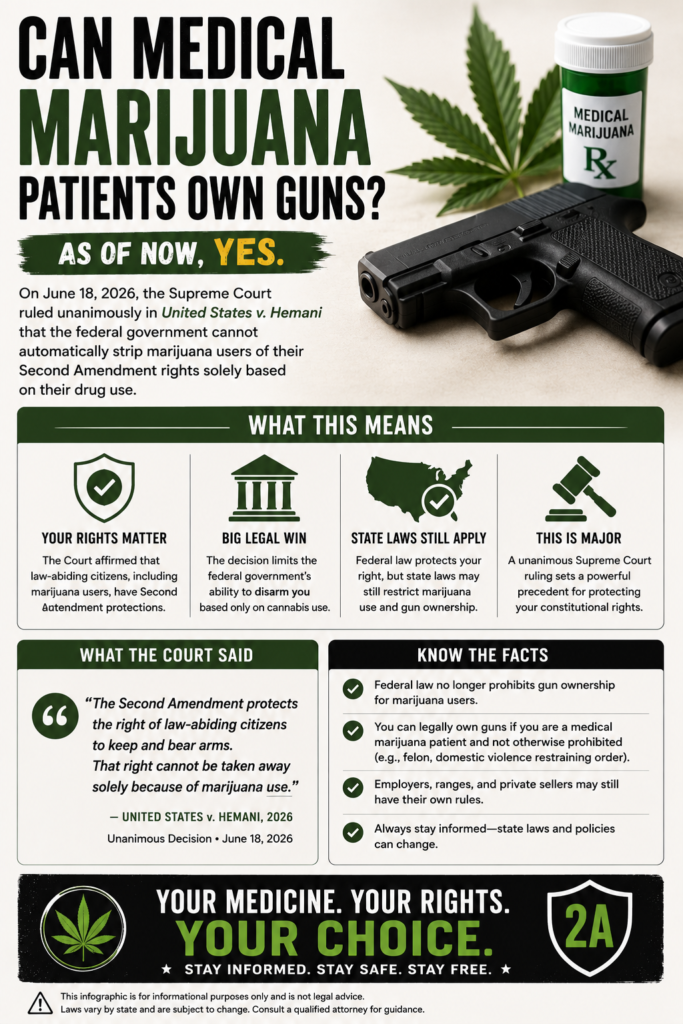
On June 18, 2026, the United States Supreme Court issued a unanimous decision in United States v. Hemani, a case that could have major implications for marijuana users across the country. The Court ruled that the federal government could not automatically strip a person’s gun rights simply because that person uses marijuana.
The decision immediately became one of the most important marijuana-rights and Second Amendment cases in recent years.
Quick Answer
The Supreme Court ruled that the federal government cannot automatically treat all marijuana users as dangerous and remove their Second Amendment rights solely because they use marijuana. However, the Court did not completely eliminate all firearm restrictions involving controlled substances, meaning the legal landscape remains complicated.
Why This Case Matters
The case involved Texas resident Ali Hemani, who challenged a federal law that made it illegal for certain unlawful drug users to possess firearms.
Federal prosecutors argued that marijuana use alone was enough to justify disarming him.
The Supreme Court disagreed.
Justice Neil Gorsuch, writing for a unanimous Court, concluded that the government failed to show that prosecuting Hemani complied with the Second Amendment. The Court rejected the idea that marijuana users can automatically be treated as dangerous simply because they use marijuana.
The Problem That Existed Before This Decision
For years, marijuana users found themselves trapped between state law and federal law.
Many states legalized:
- Medical marijuana
- Recreational marijuana
- Cannabis-related products
At the same time, federal law continued treating marijuana as a controlled substance.
That created confusion for millions of otherwise law-abiding Americans.
A person could be following state law while still worrying about federal firearm restrictions.
Why Medical Marijuana Patients Paid Close Attention
I’ve noticed that medical marijuana patients were often the most concerned about this issue.
Many use cannabis for:
- Chronic pain
- PTSD
- Cancer-related symptoms
- Neurological disorders
- Other physician-approved conditions
Yet they faced uncertainty about whether exercising one legal right could jeopardize another.
Does Medical Marijuana affect your gun rights?
That uncertainty helped make the Hemani case one of the most closely watched marijuana-related legal cases in the country.
The Second Amendment Connection
This ruling is not just a marijuana case.
It is also a Second Amendment case.
The Court emphasized that constitutional rights cannot simply be taken away based on broad assumptions about entire groups of people. The government must justify restrictions with more than a generalized claim that all marijuana users are dangerous.
That constitutional-rights focus is one reason this decision could influence future challenges involving firearm restrictions.
Marijuana Law Is Changing Rapidly
One thing I’ve learned is that marijuana law changes faster than almost any other area of law.
Questions involving:
- Medical marijuana
- Recreational marijuana
- Employment rights
- Gun rights
- Federal law
continue evolving every year.
That is why many legal issues involving cannabis remain active topics in courts across the country.
What The Supreme Court Did Not Decide
One thing I’ve already noticed since the Hemani decision is that many people are treating it as if the Supreme Court completely eliminated every federal firearm restriction involving marijuana.
That is not what happened.
The Court ruled that the federal government could not automatically strip Ali Hemani of his Second Amendment rights simply because he regularly used marijuana. The justices rejected the government’s broad theory that all marijuana users could be treated as dangerous without examining the individual circumstances.
However, the Court did not strike down every application of the federal law.
Instead, the ruling focused on the specific prosecution before the Court and emphasized the government’s failure to justify applying the law to Hemani under the Second Amendment.
Why The Decision Is Such A Big Deal
Even though the ruling is relatively narrow, it could have enormous consequences.
For years, federal prosecutors argued that marijuana use alone was enough to justify a firearm ban.
The Supreme Court unanimously rejected that argument in Hemani’s case.
That matters because millions of Americans now live in states where marijuana is legal for medical use, recreational use, or both. The Court acknowledged the government’s attempt to automatically disarm marijuana users raised serious constitutional concerns.

Medical Marijuana Cards And Gun Ownership
One question I expect to hear repeatedly after this decision is:
“What if I have a medical marijuana card?”
The answer is still complicated.
While the Hemani decision is extremely favorable to marijuana users, federal firearm laws and state marijuana laws do not always align perfectly.
That is one reason gun owners and medical marijuana patients should continue paying close attention to legal developments in this area.
Federal Law And State Law Still Do Not Always Match
This conflict has existed for years.
Many states have legalized marijuana in some form.
At the same time, marijuana continues to create legal questions under federal law.
The Hemani ruling highlights just how difficult that conflict has become.
The Court noted the government was attempting to automatically remove a constitutional right based solely on marijuana use without showing that the individual posed a danger.
Read The Actual Supreme Court Decision
One thing I always encourage readers to do is review primary sources whenever possible.
If you want to see exactly what the Supreme Court said, you can:
Read the full Supreme Court opinion in United States v. Hemani
The official opinion explains the Court’s reasoning in much greater detail than most news reports.
Why This Also Matters For Constitutional Rights
Although many people are discussing Hemani as a marijuana case, it is equally important as a constitutional-rights case.
The Court concluded the government could not automatically deprive a person of Second Amendment rights merely because they fell into a broad category of marijuana users.
For readers interested in broader constitutional-rights issues, you may also find helpful information in:
Can Police Search Your Phone Without Permission?

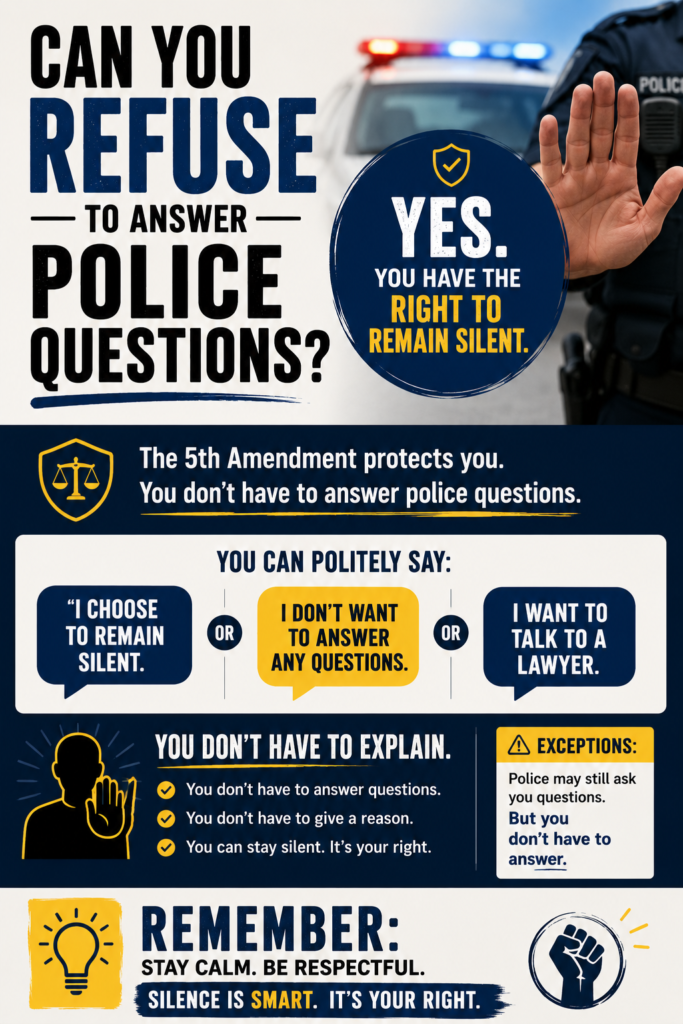
Can You Refuse to Answer Police Questions?
Can Police Search Your House Without a Warrant?
Frequently Asked Questions
Can medical marijuana patients own guns now?
The Supreme Court ruled that the government could not automatically strip Ali Hemani of his gun rights solely because he used marijuana. However, firearm laws remain complex and continue evolving.
Did the Supreme Court completely strike down the federal gun ban?
No. The Court issued a narrower ruling focused on the government’s prosecution of Hemani rather than invalidating every application of the law.
Why is United States v. Hemani important?
The decision represents one of the most significant Supreme Court rulings involving marijuana users and Second Amendment rights in recent years.
Can marijuana users automatically lose their gun rights?
The Court rejected the government’s argument that marijuana use alone automatically justifies removing Second Amendment rights.
Where can I read the actual opinion?
You can review the Court’s official decision here:
Read the Supreme Court’s Hemani opinion
Important Information
This article is provided for educational and informational purposes only and should not be considered legal advice. Marijuana laws, firearm laws, constitutional-rights issues, and federal regulations continue to evolve. Consult a qualified attorney regarding your specific situation.
For more information about our content standards, visit our Editorial Policy and Fact-Checking Policy pages.
Additional information about this website can be found on our About Us, Contact Us, FAQ, Disclaimer, and Terms and Conditions pages.
About the Author
Jennifer Brooks is a legal research contributor for Legal Know It All who focuses on marijuana laws, constitutional rights, consumer legal issues, and emerging legal developments. She researches evolving legal topics affecting everyday Americans and helps readers understand complex legal decisions in plain English.
As an Amazon Associate we earn from qualifying purchases through some links in our articles. Learn more.